The Mosque of Hasan al-Salah is located in the middle of the modern village of Al-Bahnasa that is partly built over the ancient city of Oxyrhynchus. The mosque is known as belonging to al-Hasan Ben Zein al-Abadeen (or Ali Ben Zein al-Abadeen Ben al-Hussein Ben Ali Ben Abi Taleb).
The mosque was probably built in the Abbasside Period and then renovated in the Fatimid Period. In 1846, the mosque partialy collapsed due to an earthquake subsequently went out of use. It was partly renovated in 1850 and most recently by the SCA between 2000 and 2010. Before the SCA restorations, the western façade of the mosque was covered by new buildings like shops and magazines. The water cistern of the mosque was discovered when the new buildings were removed. During the restorations, excavations were carried out in the court of the mosque to identify the original locations of the missing columns. The bases of the columns were discovered in situ, which helped the conservators re-installing the missing six columns in their approximate original location. Before the restoration the mosque did not have the triangle decoration on the top façade;the conservators copied the style from the al-Lamati mosque in Menia.

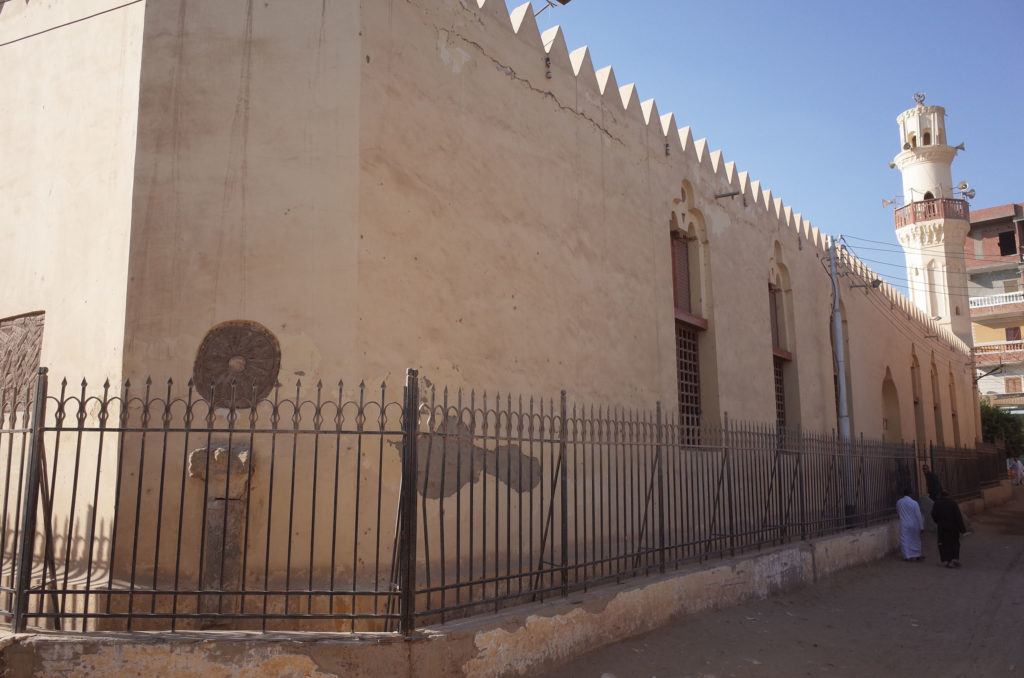
Its outer walls are barely decorated. Only two square and one round panels have geometric ornaments, and one corner of the building contains a reused Roman column with a capital.
The inside of the mosque is divided into two halls and one open court. One hall has three rows of six columns each, whereas the opposite hall, which includes the mihrab, has four rows with the same number of columns. It must be noted that the eastern columns are attached to the eastern wall of the mosque so that they appear as half-columns. Columns of pink granite, limestone and marble crowned by capitals of Corinthian order surround the courtyard. One of the columns has a twisted shaft. All columns are relatively slim.
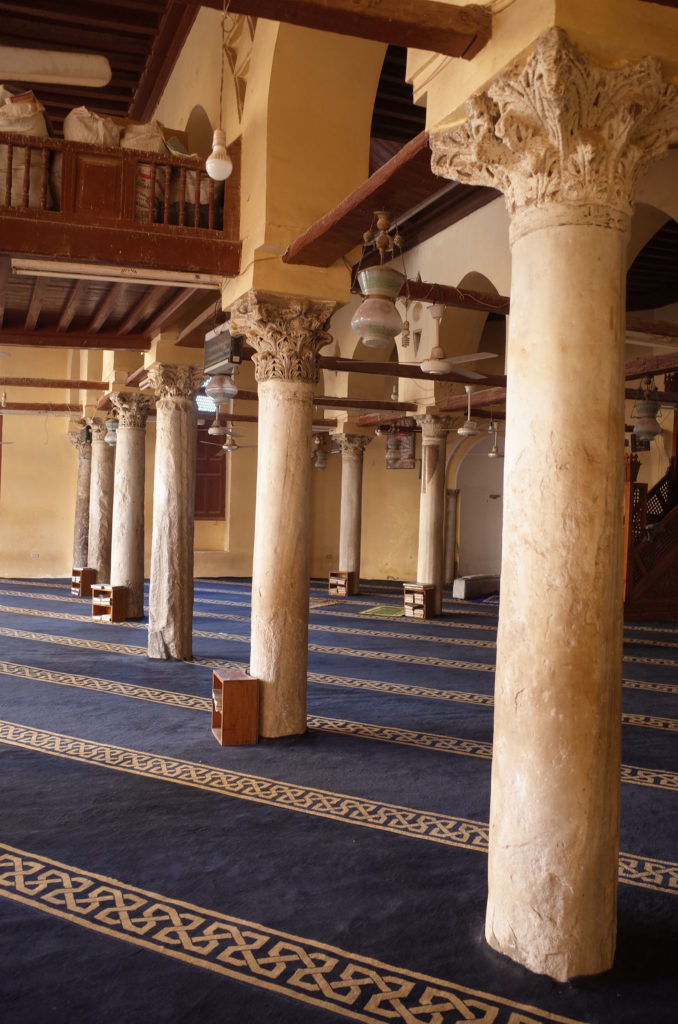
The first row of columns in the northern hall, farthest away from the mihrab, consists of three limestone columns, two are made of marble, and the column at the wall is made of pink granite. All of them have Corinthian capitals.
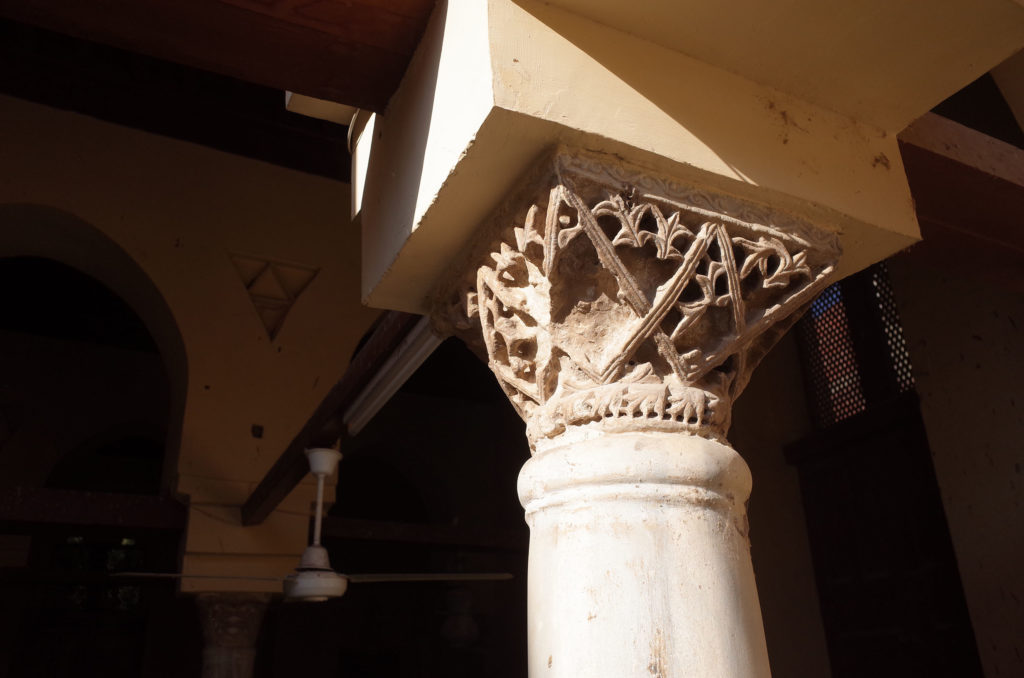
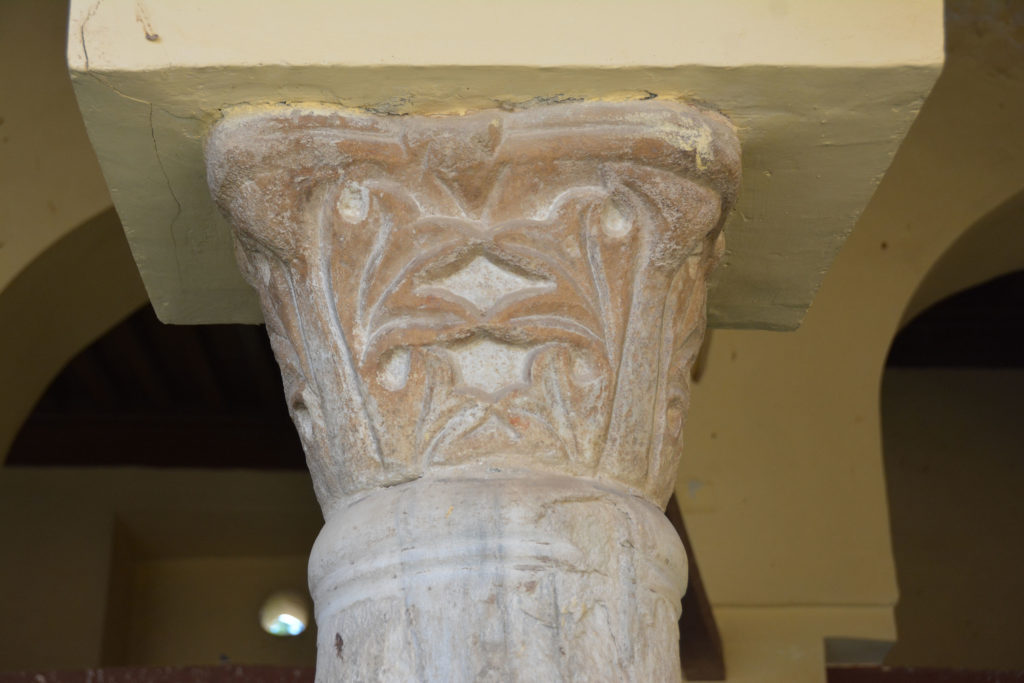
The largest variety of capitals can be seen in the second row: apart from the Corinthian order, there is also one plant capital (Late Roman) and one geometric capital.
The third row has columns of marble and limestone, five Corinthian capitals and a floral one.
The second row also consists of marble columns, one of them with a twisted shaft. All capitals are decorated in Corinthian style. Again, all columns of the third row are made of marble; they all have Corinthian capitals.
Consequently, it is no surprise that the last row is also exclusively made of marble columns with Corinthian capitals; this is also the case with the two columns that flank the undecorated mihrab. One column has an Arabic inscription in thuluth script mentioning that al-Hasan ibn Saleh founded the mosque and that he died in AH 934. A second inscription in Kufic is found on an upside-down block used as a base for one of the columns. The reused block mentions the victory of Mohamed al-Marghali. The date is probably the 8thor 9th CE.
There are two mihrabs in the mosque. The original mihrab is in the centre of the mosque; in a later period, it seems to have been suppressed with the second one, probably during one of the renovations/restorations phases. The new mihrab was built in the southeast corner to correct the orientation for praying.
The mosque probably has a secure Fatimid foundation, as mentioned by the Comité. Over forty wooden fragments with writings belonging to the Fatimid period were found in the old minbar. They were transferred to Cairo in the 1930s; however, there are no other records of them.
Al-Bahnasa has hosted different mosques since the Arab arrival; unfortunately, so little has remained to evidence the city’s glory in the Medieval periods.
Bibliography
Bulletins – Comité de Conservation des Monuments de l’Art Arabe 1896 Kuwait excavations at Bahnasā/Oxyrhynchus (1985-1987): final report. Géza Fehérvári et al (edited by) Albert Harvey Pincis and Huda al-Zahem. 2006 إشكالية اعمال الترميم والحفاظ على التراث المعماري من خلال ترميم بعض اثار البهنس الإسلامية دراسات في اثار الوطن العربي ١٨، احمد عبد القوي محمد.